

Modena, 19th of April 2024 – 11th of Nissan 5784 – 4 days until Pesach.
Just as it was 3 days before Pesach when this speech was written by the Lubavitcher Rebbe - which I report here from Chabad.org because I really like his way of explaining the meaning of "Holy Ark," that is, where we place the sefer Torah (or sefarim since there are usually more than one) in the synagogue.
” By the Grace of G‑d
12 of Nissan, 5734 [Aprile 4th 1974]
Brooklyn, N.Y.
To All Participants in the Presentation of the Aron-Kodesh
On the Occasion of the 11th of Nissan, 5734
Greeting and Blessing:
The Presentation of such a sacred and meaningful object, as well as the time and place of the event, call for a special reflection. All the more so in the light of the teaching of the Baal Shem Tov to the effect that everything that happens in life can, and therefore should, serve as a practical lesson to the thinking person in his daily life and conduct. The basis for this is the fact that everything that happens comes to pass, of course, by Hashgacha Pratit i.e. Divine Providence in every detail.
Thus, the said Presentation provides a great deal of food for thought, some of which I wish to share with you in this letter.
A human being is called a world in miniature (microcosm). Our Sages point out that this is not merely a phrase, but that the analogy corresponds in many details, even minute details.
The idea behind this analogy is that man and the world in which he lives are intimately bound up and mutually affect one another.
The idea of an Aron-Kodesh (Holy Ark) is that it is a physical thing, made of wood, or metal, or other material, and is consecrated to house a Sefer Torah, which is also made of material things (parchment inscribed by quill and ink), but is holy because the writing is the word of G-d, the ultimate of all that is spiritual and sacred. Because the Aron-Kodesh is such a holy thing by reason of its housing the holiest of all sacred objects, the Sefer Torahit is customary to make it beautiful — as is, indeed, the case with the one which has been presented. Even when an Aron-Kodesh has lower compartments, these are used exclusively for keeping other sacred objects.
A human being is like an Aron-Kodesh. The body, consisting of tissue, bone, etc., is physical, but it houses the soul which is spiritual, sacred and pure. Consequently, the body, too, must be kept holy, as an Ark housing a Sefer Torah.
Indeed, the analogy may be extended to the whole world at large, wherein G‑d commanded to construct a Mikdash, a Sanctuary, from which G‑d's light and holiness should spread to, and permeate, the whole world.
In like manner, an individual must endeavor to make his heart and brain (mind) — though they are made of physical substances — sanctuaries," that is, sacred depositories for even more sacred contents and qualities, attuned to the supreme holiness and perfection which G‑d revealed in His Torà and Mitzvoth. So much so, that even the lower compartments, i.e. when the mind and heart are applied on a lower level, namely, to such material things as business or job, these are not to be an end in themselves, but a means to a better and higher spiritual level, thereby giving the mundane occupations a different complexion, a higher meaning and value. This would then correspond to the Sanctuary which G‑d commanded to be erected in this material world, the Sanctuary to which the Jewish people contributed such material things as gold, silver and brass, whereby they elevated to sanctity not only the contributions themselves, but also the effort that went into the acquisition of all their material things, including the major share that is used for personal and family needs.
Both sanctuaries — the sanctuary that is within every Jew, man and woman, and the Sanctuary which G‑d commanded to be built as a dwelling place for Him on earth, are mentioned in one and the same sentence in the Torah: They shall make Me a Sanctuary, that I may dwell within them — Within each and every one of them, as our Sages interpret this verse. In other words, the ultimate purpose of the Sanctuary built for G‑d is to make every Jewish heart and mind a fitting abode for G‑d to dwell in.
The immediate inference from the above is that although, at this time, the Sanctuary, the Bet Hamikdash, is not in existence, and will be rebuilt when Moshiach will come, the sanctuary which is within the Jew, man or woman, is always there, and it is very much up to himself and herself to cultivate and make it effective in sanctifying the whole daily life.
In light of the above, together with my heartfelt appreciation of the sentiments that accompanied the Presentation, I wish to express my prayerful hope that it will stimulate all participants to strengthen the determination to make an Aron-Kodesh of his and her personal life, an Aron-Kodesh of the family, to the extent of permeating also the children with the same spirit and dedication. With such resolve, Divine assistance is assured, and may G‑d grant that it should be accomplished in the spirit of these days, when the Presentation was made, namely in the spirit of true freedom from all distractions material and spiritual.
Moreover, the place of the Presentation is likewise auspicious, for it has been here that my saintly father-in-law made his Sanctuary — a sacred House of Prayer and of Study — during the last decade of his life on earth, a Sanctuary which is continued in the same spirit.
Wishing you and all yours a Kosher and inspiring Pesach,
With blessing,
M. Schneerson ”
The extraordinary thing for me about this address by Rav Schneerson, 50 years ago, is the language with which he, in explaining the 'Holy Ark, or Aron Kodesh, describes some basic points of Judaism but also of Family ethics and even of Ayurveda! (2* paragraph)
Yesterday, April 18, 10th of Nissan, was Yom Aliyah, the day on which we commemorate the return, the immigration of Jews from the Diaspora to the State of Israel. I celebrated the day by carrying out my albeit reduced (this year, due to the need to protect my bones and muscles from too much strain) Pesach cleaning, aimed especially at the elimination from our kitchen of Chametz i.e., any food or substance that contains yeast or is prone to leavening in contact with water (bread pasta etc.). In short, a healthy downsizing of my ego, in favor of the Self, my soul.
I celebrated Yom Aliyah with my heart and mind vibrating with joy, joy that, especially in this year 5784 for me means, at the same time: happiness of living in unison with my Jewish community; an excruciating grief for the death and destruction inflicted on Israel 6 months ago and continued every day still thinking of those kidnapped, raped or left to die; astonished dismay at the work and communications ofanti-semitism-anti-giudaismwhich since the pogrom of 7October2023 - literally, that is, not a week or a month later - has erupted all over the world; hope (because a Jewish woman cannot afford not to be hopeful) that nourishes, along with pragmatism, the meaning of life, family, society, to start living again, always. In a word, I celebrated my ideal project of making aliyah myself, b'ezrat Hashem, or if G-d willing as my grandmother Dirce used to say.
Am Yisrael Chai! Shabbat Shalom, Lior
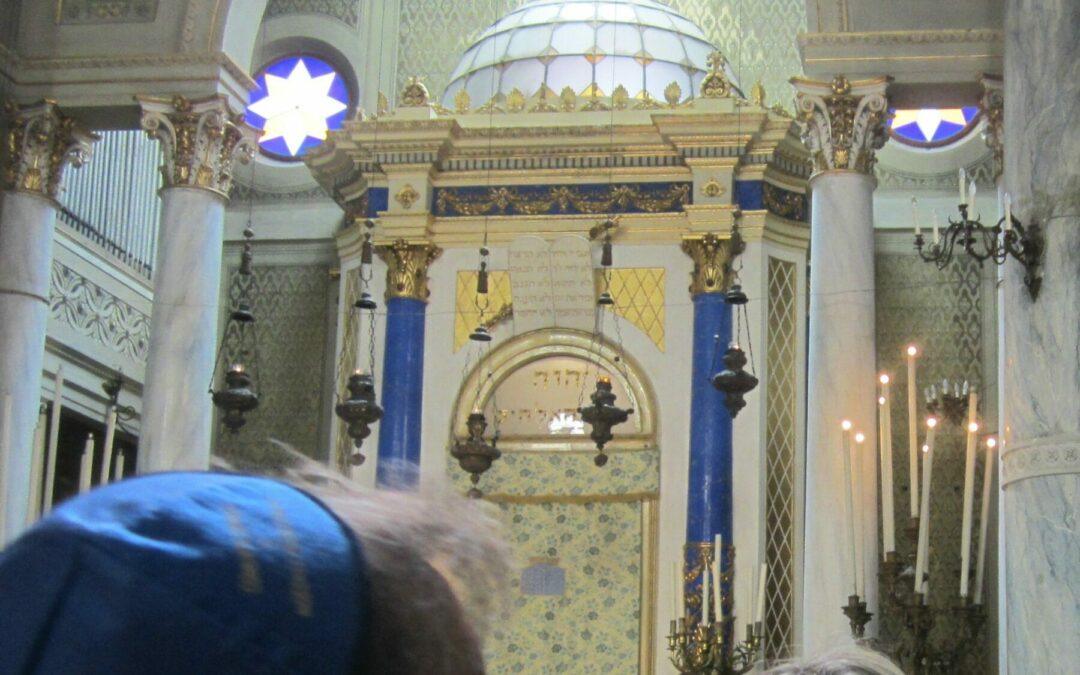
(in the photo, the Aron-Kodesh in the Mikdash of the synagogue of Modena)