


(continued)
I always was silent in situations of danger or fear. I was 8/9 years old, at my grandparents' in the country. One August night like many others, they put a long table under the pergola and we all had dinner together with relatives and friends. Uncle C. asked me to go to the nearby village to buy him cigarettes. I hopped on my bike, happy to be of service, and set off on a new adventure: coming back, a few metres from my grandparents' gate, a man standing next to his car, which was occupying part of the road, beckoned me to stop as if to ask for information. I braked, without getting off the bike, and immediately he slipped his hand under my denim skirt, running my thigh to my groin. I instantly folded my left leg, ripping his arm out of my body, thus impetuously creating a spinning wave that propelled my pedalling. I reached the courtyard at full speed, my heart in my throat, but I didn't say what had happened to me; where could I have turned to be believed, defended? Perhaps to an irascible man like my grandfather, who never saw me? Or to my grandmother, who always put up with his offensive behaviour? Or to my uncle, who always turned everything into a joke? Or to my mother, who didn't expose the mutually abusive relationship with my brother? Or to my sister, who at that time was light years away from me?
As a therapist told me many years later, my family was used to ''make coffee for the enemy'', only then recriminating with each other out of frustration.
Even as a child, I had a flair for business: I remember when during the summer in the country, playing with my cousins and friends, I invented the "toll" for farm carts crossing the yard from the road to the fields, to be paid in leaves from the hedge. Let's just say that the workers we were halting, under a blazing sun, for this playful request, were far too patient for a while, but then Grandma intervened!
One evening, even my father was at the big table at my grandparents' (after all, it was Christmas!), and I was both excited and careful not to make any false moves in his eyes. Uncle B. manned the conversation as usual: I stood next to him while he was playing by setting the thin orange paper wrappers on fire, and I was enchanted watching them fly up in sparks. He also had a few bank- notes close by, I don't know why. He told me "you see, money is like this paper ... it's worth nothing ..." then he took a banknote, flipped it in the air with a snort between his lips and asked me "isn't it?" I hesitated, then tentatively said " .. yes' and he severely scolded me "No, that's wrong! It is everything! ". I was mortified.
There was that time when I asked my father how much he earned from his work and he turned on me angrily asking me if my mother had told me to ask. She hadn't. But I was petrified and that night I slept on his carpet, while he could not see.
My mother and I were having pizza together, I still remember the place and the table. I had just come back from London, she asked me about it, so I expressed my feelings of fascination for my father. In a subtle, sarcastic voice, she said: "you have made a tribute to your father". I was astonished and felt like a monster; once home, I consulted a dictionary, and there I learned that it was not right to appreciate my father. So why was I sent there?
With both my parents there were not so many boundaries in terms of privacy: as a teenager, once we were on a trip to Scotland, my father arranged for me to sleep between him and his partner. For years I shared the double bed with my mother.
Since I was a little girl I was passionate about reading, speaking (even if uncertain about whether I could or not) and above all listening.In the eighth grade I had developed a dream, encouraged by my Italian teacher: to attend the linguistic high school and then the school for simultaneous interpreters. At the time of the choice, no one asked me anything, evidently no one asked the teachers' opinion, as I was enrolled at the technical institute. Recently, my mother told me that that decision was due to the experiences of my siblings at the liceo.
Anyway, I usually I always find a positive side in practical situations, and I had developed a knack of always making others happy and then working out my own needs; so, in a school where I didn't understand the most of the technical subjects, I clung to the study of foreign languages and the humanities with the help of some very good teachers.
During the summer, I went for a couple of years to Sardinia to stay with my father and his wife in their golden, yet anxious, world. While working in the perfumery of friends of my dad's, I came into contact with A., the designated expert beautician, and just like that I was introduced to the world of massage which, at that time, the western world was beginning to broaden with the new insights by the Eastern philosophy. A. became for me, day after day, a mentor: seeing how I was attracted to it, how I moved in the time I could spend helping her in the realm of the wellbeing treatments, she encouraged me to consider that path. Even before I had a chance to tell my father about this news, he, evidently informed by others of my new acquaintance, confronted me one day, his blue eyes glowing with a terrifying light, and told me to stop talking to "that woman".
Back home and during high school, then, stimulated by the then very intense political climate, I developed the dream of studying journalism, but with no idea how to approach this topic with my parents. Life at home was subdued by mental illness. My mother and my brother would alternate fights with conversations on phylosophy. But also there was that time when, coming home one evening, my mother and I found blood all over the bathtub. Since we had moved to Modena, my sister, after a dangerous period of rebellion, shared her room with me and we became closer. We used to go to London together, spending the day as tourists (although the rhythm was more like a military plan). However, there too there were fights at home because of my father's temper, especially with his wife.
Sometimes, as a teenager hungry for books and new ideas, I tried to have a conversation at least with my sister that could inspire us in finding a meaning, an alternative way to exist in our family. She would brush me away saying that this was useless philosophy. I found so unfair that what was her curricula at school, at the liceo for humanities, was really what I loved and what I found inspiring for my everyday life. Instead, I was stuck with something that I didn't understand, but that my father had deemed useful.
LiOr (continued)
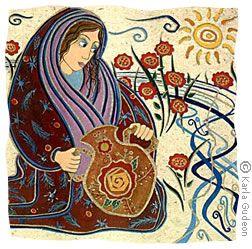
This is the second week of the Omer, whose sefira is Gevurah, Strength or Judgement – trusting yourself to know what you need. The 11th of the Omer is Netzach she’be Gevurah, endurance with strength. Dinah, daughter of Jacob and Leah, is named “judgment”. Dinah is born into a world of limitation, of gevurah, simply because she is a girl. When Dinah grows up, the severity of her world becomes even more apparent. The Bible does not give Dinah a voice to tell of her experience. We ourselves can give Dinah a voice. We can imagine that Dinah found the persevering strength, the netzach shebegevurah, to go past her victimhood and become truly free. We are most like Dinah when we find a voice to speak of our tragedies, and transcend them.(https://www.ritualwell.org/ritual/omer-11)
Photo: credit and my warmest thanks to Karla Gudeon.