


Dear grandpa Ferdinando,
today is the 169th anniversary of your birth.
The two of us have never met. I have rarely heard of you, never heard stories about you, how you lived, anything that your wife and children remembered about you. Only your name came up a few times in this form: 'Giacomo's father died when Giacomo was one year old'. My father, Giacomo, probably had no direct memory of you, but his sisters, Aunt Maria and Aunt Tatina, who were older than him, must have had some. Not to mention grandmother Lucia, who really knew you. But my parents' relations with them were always too busy with dynamics of jealousy, frustration, rebellion, to allow the little one of the house a space to ask about her grandfather.
Grandma Lucia died in 1983, I was 19, but I only have a few small memories of her as a child, like when she taught me how to wash my nose every morning, with a delicate balance between inhaling lukewarm water from the cup of my hands without swallowing it and then blowing strongly; or the benefit of drinking the yolk of a very fresh egg every day. The most mysterious memory for me, however, is when she would say: " to think that I would give my blood for them! "I don't remember the words that preceded them, or the event that triggered them. I can however imagine that she was referring to a quarrel between/with my parents.
This week's Torah reading presents the Israelites receiving of the Ten Commandments. Not a small thing, right? And yet, the name of this parasha is Yitro, the (non-Jewish) father-in-law of Moses.
Yitro sees how Moses experiences enormous difficulties in carrying out his task, which now, as Israel has become an increasingly formed society, includes administering, settling all matters between people, judging and sentencing. Moses is overwhelmed by this load and his family suffers from his absence. Yitro then intervenes, albeit unsolicited. He points out to Moses that it should not be up to him to do everything, suggesting that he select a team of associates and appoint judges to whom he could delegate, thus offering him a new way of administering the people. Moses accepts and the outcome is good. As one participant in a Torah discussion group that I attend noted, we don't even know if Yitro was kind to Moses or sharp, whether he was "a good communicator" or "an intrusive father-in-law", the fact is that he saw a problem with Moses' family suffering and he took action, Moses listened, with a good result for everyone.
For as long as I can remember, I have always heard all my family members - my mother and sister above all - speak with animosity of my grandmother Lucia, as the one guilty of interference and with responsibility in the separation of my parents. My mother, however, who was a young primary school teacher when she got married, and my father was already launched into a brilliant career in banking, always gave my grandmother the credit for having strongly advised her, back then, to specialise in teaching to disabled children because, with that qualification, she could always rely on an assignment in the cities where her husband would be sent by the bank. And so it was. So, that 'interference' was positive, in the interests of my parents' marriage.
Back to Moses, Yitro did not only criticise his actions, but presented him with a solution. Indeed, the message that we can read in this week portion is to not only pay attention to the big commandment, but to look for solutions before criticizing or protesting in our life. Unfortunately, this is also extremely relevant in the current situation of the government of Italy: we have the responsibility to find solutions before speaking negatively to our neighbours.
However, and I experience this often as I am by nature well disposed to finding and offering practical solutions to a problem, sometimes this attitude is mistaken by the recipient as an imposition (perhaps because of my enthusiasm?) and it makes me feel uncomfortable.
Did my grandmother also give mum some unhelpful criticism? Probably, and considering my mother's difficult character, she should have avoided it - as the Talmud says that it is a mitzvah to keep silent if you know you will not be heard (Yevamot 65b).
On the rare occasions I saw him, and on the very rare occasions he spoke of Grandma Lucia, my father briefly recalled that she was very strict in preventing society from taking pity on her and her children, having been widowed at the age of 35. Giacomo still had the sting of the slap she gave him for picking up an apple from the market stall. He recalled how his mother wanted to pay for medicines even though they were covered by the national health system. He remembered with dread the years spent in military school, which maybe she deemed necessary for a proper education for a young man.
When I moved to Modena in 2016, I felt crushed by the marble block that my old family, with my sister leading, maintained over our own heads. A massive block full of hate, silent grievance, bad gossip (what in Hebrew is called Lashon haRa), yet a stubborn determination to put up with the it all, shifting elsewhere the focus of the problems that should be addressed and solved, namely the injustices and various psychological disorders of us all. Seeking the healing of the issues on both dad and mum's sides.
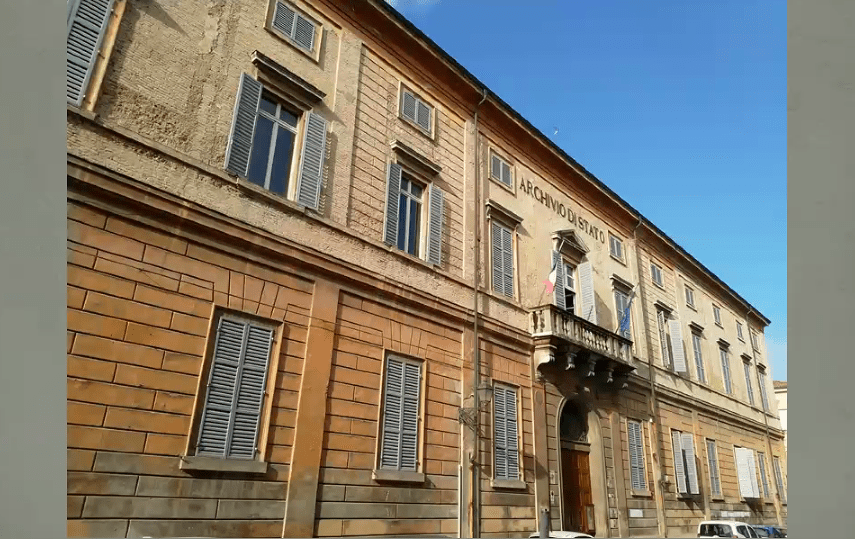
So I decided I wanted to know something about you. Since my experience of asking my father personal questions has always been terrible, I turned to the State Archives in Modena, starting out with a little bit of information about you, but finding a lot of kindness and goodwill on the part of the manager and her staff.
First of all, I discovered that you were born on 4 February 1852. Whaat? My grandfather was from mid-nineteenth century? Wow. I also learned that Grandma Lucia was your third wife, who married very young when you were 68. That you were a military man, "royal employee" as they used to say. That you took your first steps in a small mountain village above Reggio Emilia.
Indeed, thanks to the encouragement of Ariel, who is passionate about genealogy, on 1 October 2019, my father's birthday, I set off to the mountains to explore your life.
I still have a long way to go, but I intend to find out more.
Shabbat Shalom!
LiOr