


During this recent period, between Rosh Hashana and Yom Kippur, there have been many occasions offered by Judaism to take a look at the year 5780, that just ended, and at the events in our life during that time. According to the concept of Teshuvà (return) that inspires all of Elul, the last month of the old year, through the New Year's Eve until the day of atonement, we are encouraged not only to spot our mistakes and shortcomings of the last year but above all to return, to repair what is possible now, then formulate new intentions, visualizing better behaviours and actions that we will put into play in our New Year's life.
But today is the seventh day of Sukkot. So why am I still reflecting on these topics?
The festival of Sukkot comes 5 days after Yom Kippur, immediately after which we begin to build the Sukkah, the hut covered with branches in which we will spend time with our family, where we will host friends and strangers for a joyful meal. Sukkot celebrates the completion of the harvest and commemorates the miraculous protection that God gave to the Israelites as they entered the desert after the exodus from Egypt, as written in the Torah (Lev. 23): "You shall live in booths seven days; all citizens in Israel shall live in booths, in order that future generations may know that I made the Israelite people live in booths when I brought them out of the land of Egypt." Every day we take in our hands "the four species" or arba minimthat is, we shake the lulav (willow, myrtle and palm leaves) and enjoy the scent of the etrog (a kind of cedar). 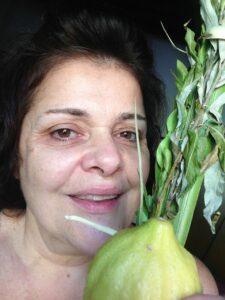 The sages of the Midrash tell us that the four species, with their different peculiarities in terms of fragrance and texture, represent the various personalities of the community of Israel/human beings, whose intrinsic unity we emphasize at Sukkot.
Sukkot has another really unique feature: in this festive period we are literally 'commanded' to be joyful, as in Torah (D'varim 16:15): “You shall have nothing but joy" ("You shall be altogether/only joyful.” והיית אך שמח)
The seventh day of Sukkot is Hoshaanà Rabbà: on this day we have an additional chance of repentance and return if after Yom Kippur we still need to clear our spirits, before the final sealing of the destiny we will have sought and deserved for the coming year.
That is why I am still reflecting on this topic: because I feel that I still need a clarification. It is not necessarily repentance, because even though I regret not having faced it before, only during these past days of Sukkot, blessed by the love of Ariel, Irene and the kitten Sara, I have finally focused on the heart of the problem.
Rabbinic tradition teaches us that in repenting and asking for forgiveness we must turn to God for sins committed against God and to individuals for sins committed specifically against them. My blog, Or Ein Sof - Light without interruption, is practically my journal, and I have decided that here I will speak in the same way: about everything that concerns me and God, therefore also about things that concern humanity and nature and the planet. I might refer to facts that happened between me and a specific person, but in abstracting the concept that I wish to analyse. Whereas I will address directly the person with whom I feel the need to clarify the air, hoping for a sincere mutual understanding.
Strange, isn't it, to be 'commanded' to be joyful?! Moreover 'completely' joyful!!! Even more so when we are asked to leave the security of our homes and reside in fragile huts covered in foliage?! And again, be joyful in time of a global pandemic?! Really?!? Well, the other day I read a wonderful article, written by my favourite blogger, Yael Shahar (https://blogs.timesofisrael.com/sukkot-the-paradox-of-joyfulness/?fbclid=IwAR1gIFA1TntSaF3ieQqfUlTB5TOKN99nrZfHMxZXAWPbynPY2kL742x3SQo) that has shone a light on this dark area of mine that I have been carrying inside most of my life, helping me to find the right words to address my family of origin but above all the right words to speak to You, God.
Since I was a little girl, I have always been joyful. Despite the terrible situations in which I found myself within the family and the reflections they had on my social life, I have always, spontaneously, turned my gaze to the good things, to the different entities that, thank you God, I often encountered and that gradually showed me where to get the branches and how to use them in order to build my virtual Sukkah, a place of peace where I could live despite its / my fragility. From this place I have repeatedly tried to express my thoughts, to make suggestions toward a constructive development of the threatening desert we were as a family. On the other hand, sometimes there may have been mixed messages: when the level of their aggressiveness was unbearable, I responded in self-defence, and so my progress has always been one step forward and two steps backwards.
But the members of my family, entrenched in their own Ego, have never taken me seriously. My joyfulness was automatically interpreted as a lack of common sense, as not being relevant in being able to help in a situation that 'we had to endure', as if I were a teddy bear from which one only expects a silent, helpless smile. Which is exactly, in my opinion, what one could take from a first superficial reading of the verse of the Torah mentioned above (D'varim 16:15): "You will therefore be completely happy" (והיית אך שמח).
This is why Yael Shahar's article has enlightened me: with her in-depth study, the quotes from teachers and the desire to render Jewish tradition and Torah always relevant and realistically useful, she highlights that, by only replacing a single letter, the first, of the wordsשמחה (simcha=joy) andצמחה (tzmichah=growth), the meaning would change giving us a very inspiring insight. Furthermore, in both English and Italian the word 'altogether/completely' can be translated as 'indeed, completely' but also 'nevertheless'.
Perhaps then a better interpretation of this passage and of the words that rabbis in history have spent on it is: The best contribution we can make to the community in which we live is to grow through suffering. Recognise our vulnerability and even rejoice in it as long as we always keep in mind that there is a divine spirit above the parts who relies on us, like with the four species, each one giving what is in their true essence to help one another. Also because, as has always been the case with my family, the joyful ones are still asked for practical help and this request should not come from desperation and as a last resort, but with respect.
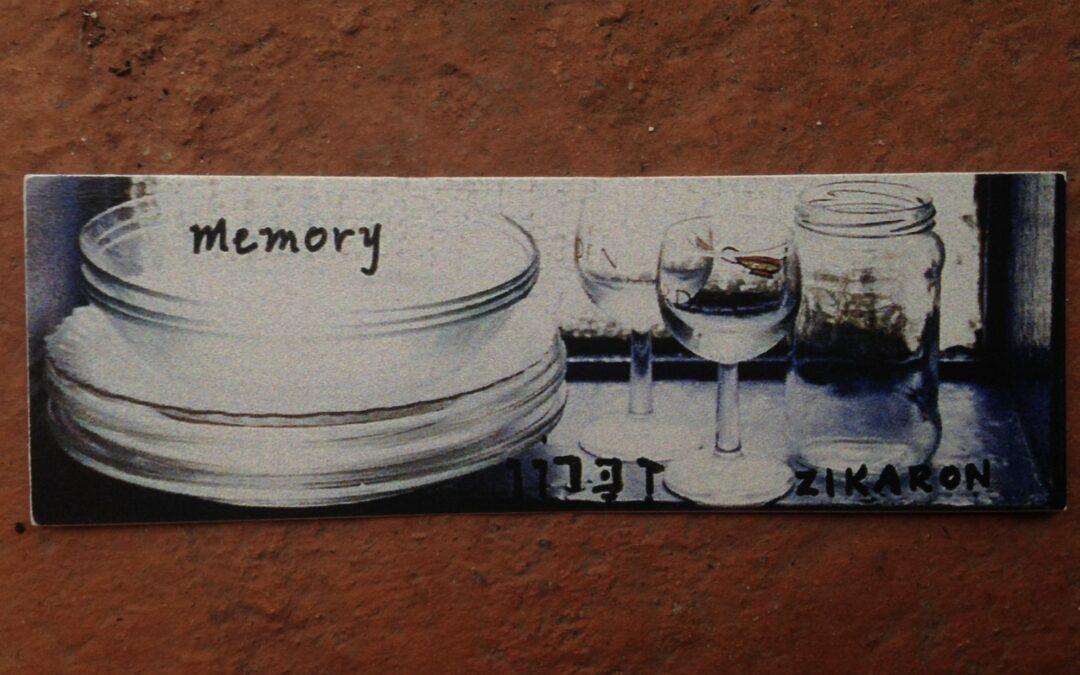
In the photo is one of the Malachim, Jewish Angel Cards, the first one I randomly picked from the lovely sachet that arrived the other as a gift from our dear Lisa in the US. They are called 'Messages of Blessing', each one contains a statement, a word, that can inspire a conversation, a reflection... and really it was a blessing for me to find the word 'memory'. By writing this post, today, I feel that I have found the way to let go of the old: the bad things that made me stronger, the beautiful teachings I received and the notions that (hopefully!) made people feel joy. Indeed, in the next days I am going to show in this website the photos of what I believe are the highlights of my creative and professional activity. In short, it will be a re-set of my memory card.
Chag Sameach!
LiOr