

As I post this last leg of my journey through the Omer, the Palestinian Arabs and Israel have reached a ceasefire. At the moment it seems to be unconditional, decisively facilitated by Egypt's intervention. I wish and pray that, whatever the outcome of future negotiations, Jerusalem will remain the centre of spiritual and civic freedom for every Jew, every Arab and/or Israeli, as well as every Christian, in peace. Peace, however, needs to be protected, just as in the individual and family life of every person in the world, even more so in a sensitive spot such as Jerusalem and the ancestral sites of Jewish biblical memory.
– part two –
In order to accommodate the new and lovely assistant, on Saturdays I would accompany her to Modena for the week end off, and on Sundays I drove her back to mama's house. Then, I asked to be free on Shabbat and I maintained the Sunday shift, plus various other duties during the week, for my mother's visits, and also for the assistant's herself, or purchasing the special furniture and accessories for mama, etc. In the meantime, I continued the paperwork and obtained the assistance support for her.
Then came Covid. I talked to my mother on the phone, and my sister was in charge for the food shopping for them, as she had always wanted to do. During the lockdown the assistant had obviously put the weekend break on hold. I have a very health-sensitive job; like all people who live together, my partner and I are mutually obliged to liaise regarding our contacts. In September 2020 the assistant resumed her weekends. When, in October, the contagions rose sharply, and we had all been, bh, spared from the pandemic, I asked my sister to arrange a meeting to see how to proceed with the carer. She texted me back 'I believe we can trust her' and that was that. I continued my shift, but felt a sense of injustice. A couple of months later the assistant had contracted the virus. My sister phoned me, "so, what do we do now?". At that point I lost it, replying "when I asked you to speak you didn't want to, now do what you want", while thoughts crowded my mind. Obviously it was a knee-jerk reaction, I think the first time ever that I spoke to her like that. Communications followed about everyone's need to be tested, my mother and brother were positive. I continued to cooperate as much as I could, not so much in person but promptly, like when my sister asked me to draw up in English a list of questions and terms for the assistant to approve in order to spend quarantine at my mother's.
Thankfully, time has passed for us all in spite of Covid. However, it has profoundly changed my life: I realised how unacknowledged I have been, almost feeling tolerated "with my quirks" and misused. Why now? Perhaps because of two defining moments: my mother's hospitalisation that saved her life amidst indecisiveness, and the authoritarian handling of a family matter related to Covid that affected everyone. More than any other situation in my life, I was struck by how little value was placed on life, both physical and spiritual, compared to the value placed on material convenience and appearances.
I made myself scarce. Around the end of March, I encouraged my mother and especially the assistant to not hesitate to directly call me for any needs. I had to take time to find a balance. During Pesach, with an acute, aching need for freedom, I felt supported, almost swept along a pathway that opened in the Sea of Reeds, exiting Egypt towards the freedom to protect what makes me purposefully unique (as each of us is), proactively nurturing my communication with others, my emotions and thoughts, my meditative time, in a word, my breathe.
Pesach made me want freedom, defying the prediction that, being born with only one kidney, my Will - the ability to assert myself - is impaired. But what helped me to see how to receive that freedom and how to use it, has been the journey in the 49 days of the Omer. From the first day, I acknowledged the "little pieces" of which also I am made, BH, as if they were my daily barley offering, with the inspiration of some women of the Tanach who, for different reasons, I find to be wondrous symbols of responsibility. So we arrived at Shavuot, at Sinai, at the moment when we received the Ten Commandments in the Torah, that is, the taking of responsibility that should follow achieving freedom.
LiOr – The End –
This is the seventh week of the Omer, Malkhut: Majesty, Dignity, Royalty, Divine Presence. Day 46 is dedicated to Netzach she’be Malkhut, with Yehosheva (II Kings 11). Yehosheva is granddaughter of Jezebel, the queen of Israel who orders the prophets of God killed. She is also the daughter of Atalya, a queen mother of Israel who orders all the males of the royal house killed, even her own grandsons, so that she can assume the throne. Yet Yehosheva defies her mother and acts to save one of the king's sons. Yehosheva hides away young Yoash and his nurse in a secret room in the Temple. Six years later, Yehosheva's husband, the high priest Yehoyada, anoints Yoash as king, and has Atalya executed. From a woman's point of view, the story is disturbing, as it depicts powerful women as conscienceless and unjust. But we also see Yehosheva, a woman, takes center stage as a moral personality.
Yehosheva has a choice—she can be loyal to her mother, and perhaps become queen herself, or she can act against her mother’s callous cruelty. Yehosheva's decision to save a child and uphold his kingship shows that her commitment is to righteousness and not only to political power. Yehosheva represents the victory, netzach, of malkhut, God's sovereignty in the world. We are most like Yehosheva when we do not idealize our own power, but rather use our strength to increase God's power in the world. https://www.ritualwell.org/ritual/omer-46!
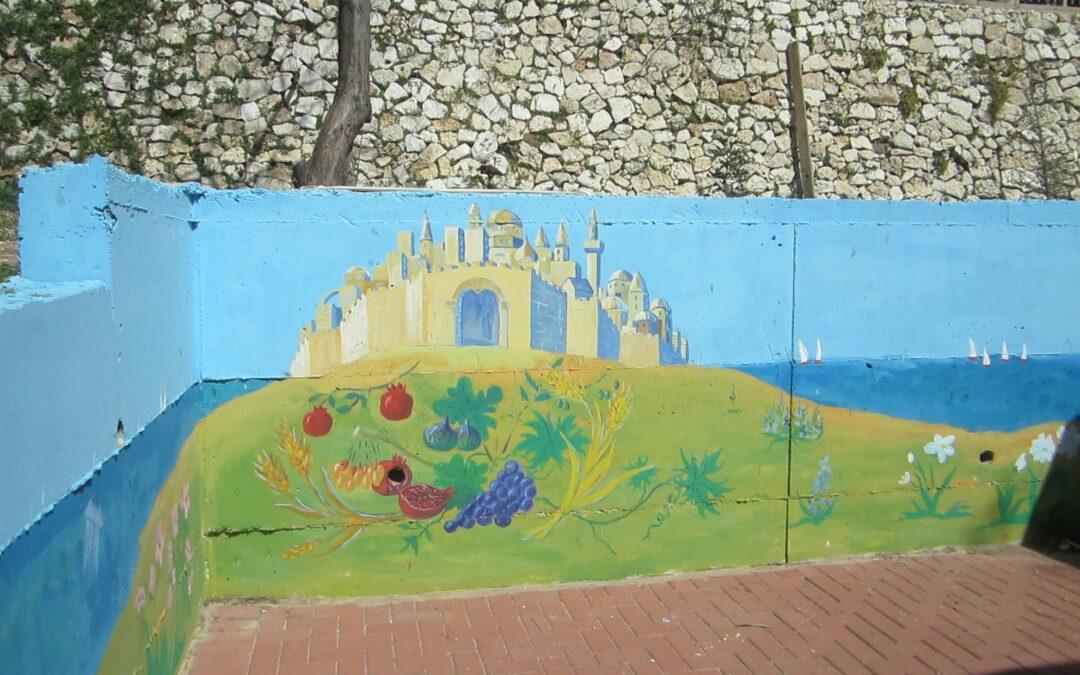
Photo: LiOr, Mural painting of Jerusalem, Netanya, Israele 2015