


Shavua tov! Wishes for a good week everybody! Today is Sunday 9 of Nissan 5782, 10 April 2022. Jews just yesterday celebrated Shabbat HaGadol, the Shabbat immediately preceding Passover or Pesach, the eve of which this year falls on Friday the 14th of Nissan, April 15 and will last 8 days.
This morning I started my new week by seeking out the warmth of the sun, with my legs persuading my pelvis not to give in to some pain but rather to follow the light, literally.
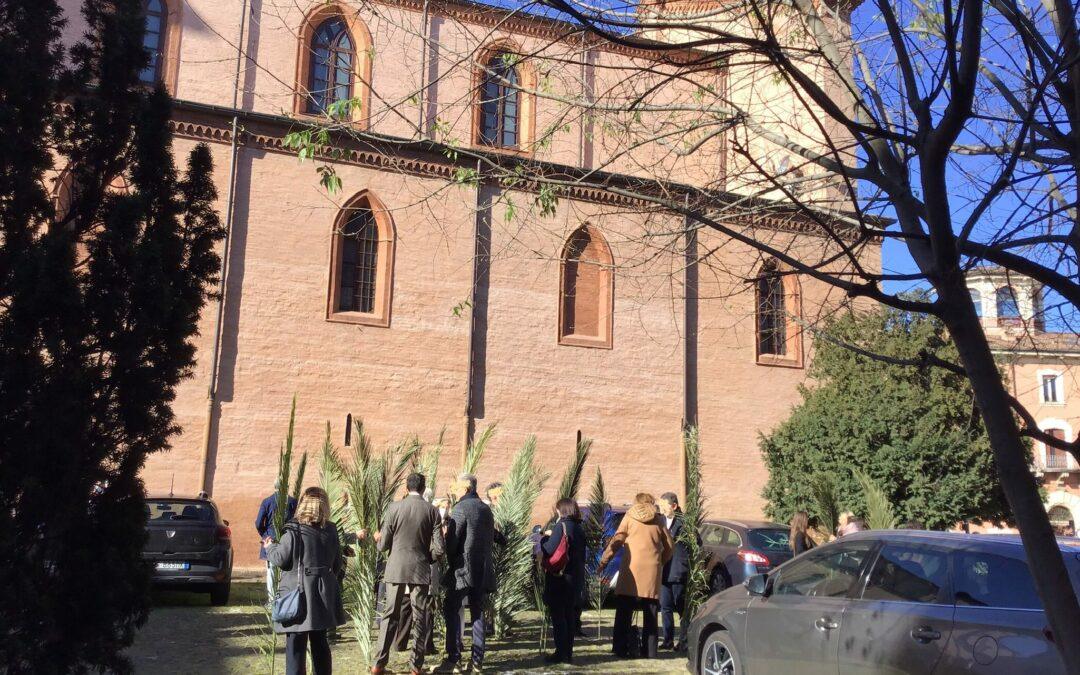
I walked from Via San Giacomo straight onto Corso Canalchiaro: it was a beautiful sight, the warm sun rays breaking through the cold shadows from a vivid blue sky, and around the church of San Francesco I could see the worshippers arriving, holding the traditional palm for the celebrations.
Of course! For Christians, whether Catholic, Orthodox or Protestant, today is Palm Sunday and the start of the Holy Week which culminates in Easter Sunday on the 17th of April.
Instinctively, at the sight of the swaying branches, I had a visual of Sukkot, the Jewish autumn festival. In fact, for example, the roof of the Sukkà - the hut - is a leafy layer, a see through, of light branches and vegetation among which, especially in Israel, it is certainly easy to find palm leaves. Then, the sight of the palm tree in the hands of my fellow citizens evoked memories of the Lulav, which together with the Etrog is the highlight of the festival of Sukkot.
I didn't even think of a connection between these two religious celebrations, certainly not because of a palm leaf. Instead, I asked myself what the significance is, what exactly the Christian world celebrates on Palm Sunday, and as soon as I arrived at my studio I went online and chose this article.
The author frames the moment in the life of Jesus (Christ for Christians) when the event at the origin of this festivity and the custom of the believers of waving palms [... as a tribute to the triumphal entry of Jesus into Jerusalem to meet his death ... ] took place.
Quickly followed by its being connected to the Jewish holiday of Sukkot [ ... when the people would journey in pilgrimage to the temple with a little bunch of intertwined palms, myrtle and willow...].
This parallel already seems very strange to me: obviously the temple referred to in Sukkot is the same temple where the young Jewish revolutionary Jesus used to hold famous sit-ins, but the Deity that the Jews were paying homage to was quite a different one. So, apart from the presence of the palm leaf (which, to be honest, is as common in Israel as a Poplar tree in the countryside of Emilia), I do not see what relationship there is between these two situations, set in the different context of belief of two different faiths and cultures.
On Sukkoth the Jewish people on pilgrimage brought to the temple the offering of a portion of the summer harvest. The "bunch", which is not small, is called Lulav, and we are commanded to shake it, in a precise order, during the days of the festival. It is always coupled with the Etrog and all together they form the four species .
On the subject of the Lulav, the author of the article (see link) suggests meanings of each species that do not seem to me to be those offered by Judaism, i.e. where each represents a gradation of qualities and goodness of the human being:
- 1 branch of a date palm, called precisely Lulav, has no scent but its fruit is tasty, symbolizing a person of no particular goodwill but of intelligence and culture
- 2 willow stalks, that has no scent, no taste, and indicates someone neither good nor intelligent
- 3 myrtle branches, this has no taste but is fragrant, and represents a good and dedicated person even if not particularly educated or intelligent
- the Etrog, similar to a large citrus, which we are commanded to hold in our hands and smell, has as its most important task to be beautiful, without blemishes (so much so that its selection implies a high price and is comparable to a sacrifice) in order to fulfil the hiddur mitzvahwhich means "to beautify" a mitzvah, a commandment. Indeed the Etrog is both good in taste and fragrant, and also beautiful. All these aspects led the midrash (legend) to suggest that this could be the forbidden fruit of the Garden of Eden, since its trunk is as beautiful as the fruit, and would correspond to the words of the Scripture "Eve saw that the tree was beautiful ...".
Since I believe that it is wonderful to learn about the traditions and especially the founding principles of religions other than one's own, I am sorry to read confusing explanations under the guise of so-called references and common belonging: being different is not a flaw, and we must have the courage and be proud of our choices.
Kosher Pesach Sameach to all Jews, and a warm wish for a meaningful Easter to the Christians who celebrate it.
LiOr